
Your Garage Door Springs Are Doing More Work Than You Think
Every time you open and close your garage door, the springs are doing the heavy lifting — literally. A standard two-car garage door can weigh anywhere from 150 to 300 pounds, and the springs are responsible for counterbalancing all of that weight. Without them, your garage door opener couldn't move the door at all.
Yet most homeowners in Bonita Springs never think about their garage door springs until one snaps. And when that happens, it usually comes at the worst possible time — you're running late for work, loading up for a beach day, or trying to pull into your garage during a summer thunderstorm.
Understanding how long your springs should last, what wears them out, and when to replace them can save you from an unexpected (and potentially dangerous) breakdown.
How Long Do Garage Door Springs Typically Last?
The lifespan of a garage door spring is measured in cycles. One cycle equals one full open-and-close of the door. Most standard torsion springs are rated for approximately 10,000 cycles, while high-cycle springs can be rated for 25,000 or even 50,000 cycles.
So how does that translate to years? It depends on how often you use your garage door:
- 2 cycles per day (once out, once in): A standard spring lasts roughly 13-14 years.
- 4 cycles per day (typical for families): A standard spring lasts about 7 years.
- 6-8 cycles per day (busy households, home businesses): A standard spring may only last 3-5 years.
If your garage door is the main entry point for your home — which is the case for many households in Bonita Springs and the surrounding areas — you're likely putting more cycles on your springs than you realize.
Why Springs Fail Faster in Southwest Florida
Those cycle estimates assume average conditions, but living in Southwest Florida introduces a few factors that can shorten the lifespan of your springs significantly.
Salt Air and Corrosion
Bonita Springs sits just minutes from the Gulf of Mexico, and the salt-laden air that rolls in off the coast is tough on metal components. Garage door springs are made of steel, and salt air accelerates rust and corrosion. Over time, corroded springs lose their flexibility and become brittle, making them far more likely to snap without warning.
Heat and Expansion
Florida's intense heat causes metal to expand and contract repeatedly. During the summer months, your garage can easily reach temperatures of 120°F or higher. This constant thermal cycling adds stress to the springs beyond the mechanical cycles they're already enduring.
Humidity and Moisture
High humidity means moisture is constantly present on metal surfaces. Even if you don't live directly on the water, the ambient humidity in our area is enough to promote rust on unprotected springs. This is why lubrication and preventive maintenance are especially important here.
Warning Signs Your Springs Are Wearing Out
Springs rarely fail without giving you some advance notice. Here are the key signs to watch for:
- The door feels heavier than usual. If your garage door seems sluggish or your opener is straining more than it used to, the springs may be losing tension.
- The door doesn't stay open. A properly balanced garage door should stay in place when opened halfway. If it slides down, the springs are weakening.
- You hear loud squeaking or grinding. While some noise is normal, excessive squeaking or popping sounds can indicate that the springs are dry, corroded, or near failure.
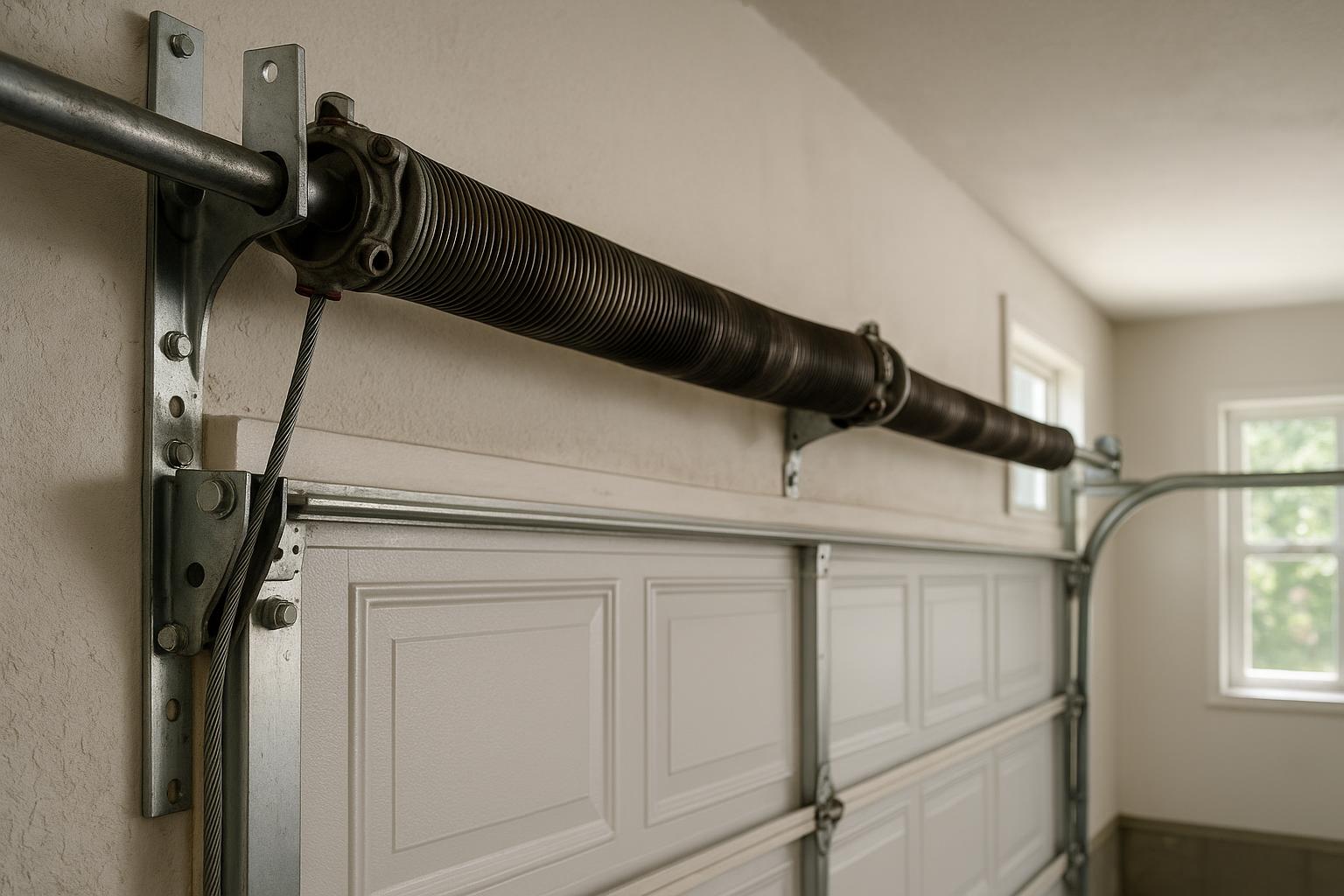
- Visible gaps in the spring coils. Torsion springs are mounted above the door. If you see a visible gap or separation in the coils, the spring has already broken.
- The door opens unevenly. If one side of the door lifts faster than the other, one spring may be weaker or broken, especially on doors with two springs.
- The opener struggles or stops mid-cycle. Your opener is designed to work with the assistance of balanced springs. When springs weaken, the opener has to work harder, which can burn out the motor prematurely.
Can You Replace Garage Door Springs Yourself?
This is one of the most common questions we get, and the answer is straightforward: we strongly recommend against it.
Garage door springs are under extreme tension. A torsion spring stores enough energy to cause serious injury or even death if it's released improperly. Every year, emergency rooms across the country treat injuries from DIY garage door spring repairs gone wrong.
Professional technicians have the specialized tools, training, and experience to replace springs safely. The job typically takes less than an hour for a trained professional, and the cost is far less than an emergency room visit.
Should You Replace One Spring or Both?
If your garage door has two torsion springs and one breaks, you might be tempted to only replace the broken one. While that will get your door working again, most garage door professionals — including our team — recommend replacing both springs at the same time.
Here's why: if one spring has reached the end of its lifespan, the other one is almost certainly close behind. Replacing both at once ensures balanced operation, prevents a second service call in the near future, and saves you money on labor in the long run.
How to Extend the Life of Your Springs
While springs won't last forever, there are steps you can take to get the most out of them:
- Lubricate your springs regularly. Apply a silicone-based or white lithium garage door lubricant to the springs every three to four months. This reduces friction, prevents rust, and helps the coils move smoothly. In Bonita Springs, where salt air and humidity are constant, quarterly lubrication is a must.
- Schedule annual maintenance. A professional tune-up includes spring inspection, balance testing, lubrication of all moving parts, and hardware tightening. It's the single best thing you can do to prevent unexpected failures.
- Consider high-cycle springs. If you use your garage door frequently, upgrading to high-cycle springs during your next replacement can dramatically extend the time between service calls. The upfront cost is higher, but the long-term value is excellent.
- Keep your garage door balanced. An unbalanced door puts uneven stress on the springs. If your door doesn't pass the balance test — staying in place when manually lifted halfway — call a professional to adjust the tension.
When to Call a Professional in Bonita Springs
If you've noticed any of the warning signs mentioned above, or if it's been more than a year since your last garage door maintenance appointment, it's time to have your springs inspected. Catching a weakening spring before it breaks means you get to choose when the repair happens — instead of being caught off guard on a Monday morning.
At Bonita Springs Garage Door Experts, we inspect and replace garage door springs for homeowners throughout Bonita Springs, Estero, Naples, Fort Myers, and Cape Coral. We carry a wide selection of standard and high-cycle springs on our trucks, so most replacements are completed in a single visit.
Whether your spring has already snapped or you just want peace of mind that your door is safe and reliable, give us a call. We'll show up on time, give you an honest assessment, and get the job done right.