
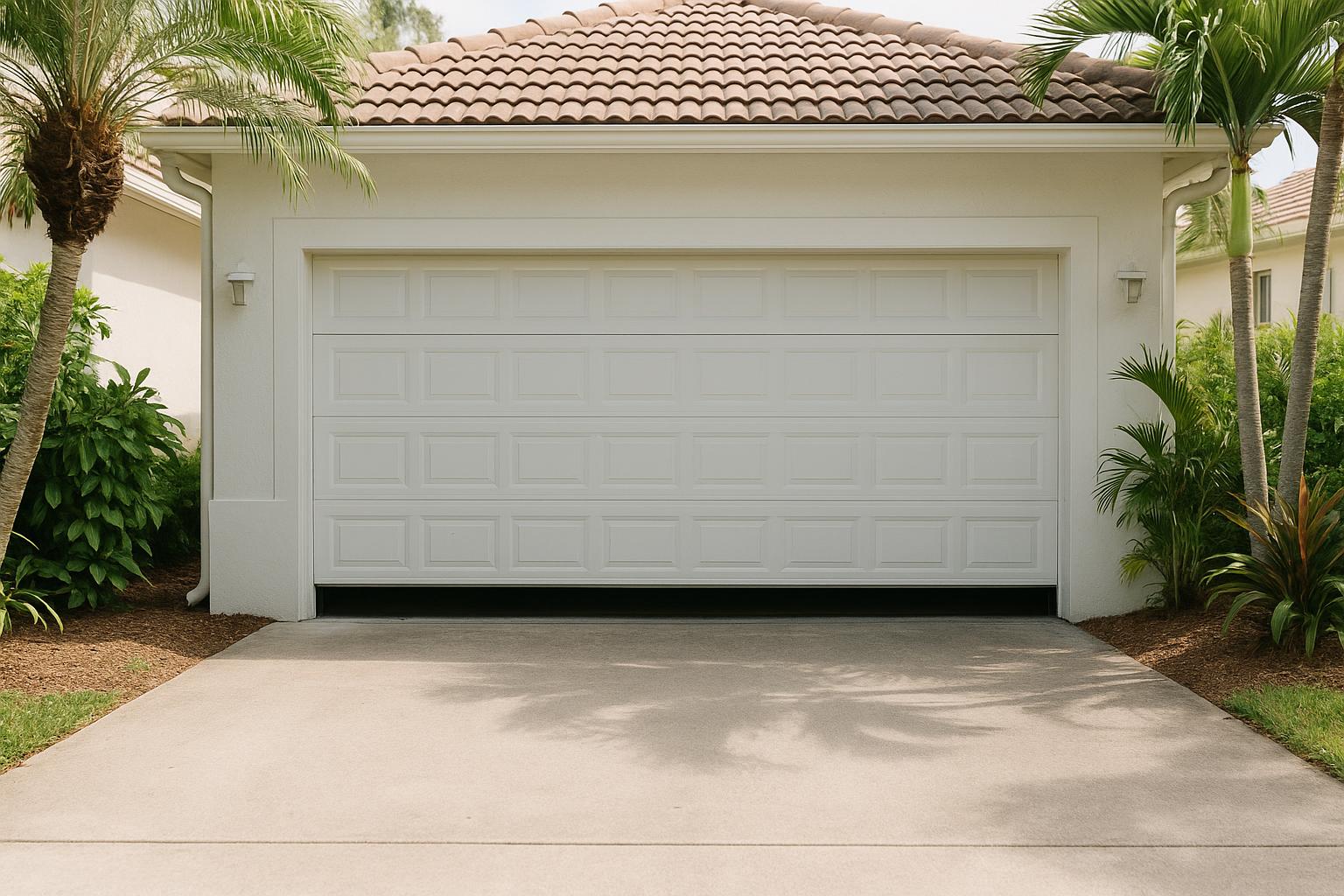
That Frustrating Moment When Your Garage Door Won't Stay Closed
You press the button on your remote, watch the garage door start its descent, and then — just before it reaches the floor — it stops and reverses right back up. You try again. Same thing. Maybe you try holding the wall button down, and it finally closes, but the moment you let go, up it goes again.
This is one of the most common garage door complaints we hear from homeowners in Bonita Springs, and the good news is that it's almost always fixable. The bad news? Ignoring it can leave your garage wide open to weather, pests, and security risks — none of which you want to deal with in Southwest Florida.
Let's walk through the most likely reasons your garage door reverses before hitting the floor and what you can do about each one.
1. Misaligned or Dirty Safety Sensors
This is the number one cause of a garage door that reverses unexpectedly. Every garage door opener manufactured after 1993 is required by federal law to have photoelectric safety sensors — small devices mounted near the bottom of the door tracks on either side. They project an invisible beam across the opening. If anything breaks that beam while the door is closing, the opener reverses the door to prevent injury or damage.
Here's the thing: these sensors don't just react to people and pets. They can be triggered by:
- Dirt, cobwebs, or debris on the sensor lenses
- Misalignment caused by a bump from a bike, lawnmower, or trash can
- Direct sunlight interfering with the infrared beam
- Moisture or condensation on the lenses, which is common in our humid Bonita Springs climate
Start by wiping both sensor lenses with a clean, dry cloth. Then check that both sensors are pointing directly at each other. Most sensors have a small LED light — typically green when aligned and amber or red when something is off. If one light is blinking, that sensor likely needs to be repositioned.
2. The Close-Limit Switch Needs Adjustment
Your garage door opener has a setting called the close-limit switch (sometimes called the down-limit or travel-limit). This tells the opener how far the door needs to travel before it considers itself fully closed. If this setting is off — even by a small amount — the opener may think the door has hit an obstruction when it's actually just reaching the floor.
When the opener senses resistance beyond what it expects, it treats it like something is in the way and reverses. This is a safety feature working correctly but with incorrect parameters.
Adjusting the close-limit switch usually involves turning a small screw on the back or side of the opener unit. Your owner's manual will have specific instructions for your model. If you're not comfortable making this adjustment yourself, a professional can dial it in within minutes.
3. Worn or Broken Springs
Garage door springs do the heavy lifting — literally. They counterbalance the weight of the door so the opener doesn't have to work as hard. When springs weaken or break, the door becomes significantly heavier. The opener motor strains against the extra weight, interprets it as an obstruction, and reverses.
Signs that your springs may be the problem include:
- The door feels unusually heavy when you try to lift it manually
- You hear a loud bang from the garage (a spring breaking)
- The door opens unevenly or looks crooked
- The opener motor runs but the door barely moves
Important safety note: Garage door springs are under extreme tension and can cause serious injury if handled improperly. Spring replacement is not a DIY job. If you suspect a spring issue, call a professional right away.
4. Track Problems or Obstructions
The metal tracks that guide your garage door up and down need to be clean, properly aligned, and free of dents or bends. Even a small obstruction — a pebble, a piece of debris, or a bent section of track — can cause the door to bind or stick during its travel. When the opener encounters that resistance, it reverses.
Visually inspect both tracks from top to bottom. Look for anything that shouldn't be there and check for sections where the track appears bent or separated from the wall. You can clean the tracks with a damp cloth, but avoid using lubricant directly on the tracks themselves — that can actually attract more dirt. Instead, lubricate the rollers with a silicone-based garage door lubricant.
5. The Opener Force Settings Are Too Low
In addition to the travel-limit settings, most garage door openers have force settings that control how much power the motor uses to open and close the door. If the closing force is set too low, the opener may not have enough power to push the door all the way down, especially if the door has gotten heavier due to humidity absorption, aging springs, or added weatherstripping.
Like the limit switch, force adjustments are made with small screws or dials on the opener unit. Increase the down-force setting slightly and test the door. Be careful not to set it too high, though — you don't want the door to crush something because it's forcing its way past a legitimate obstruction.
6. Damaged or Worn Rollers
Garage door rollers can crack, chip, or wear flat over time. When they don't roll smoothly, the door creates more friction in the tracks. More friction means more resistance, and more resistance can trigger the opener's auto-reverse feature.
Nylon rollers tend to last longer and operate more quietly than steel rollers, and they're a popular upgrade for homeowners in Bonita Springs who have living spaces above or adjacent to the garage. If your rollers look worn, cracked, or are missing chunks, it's time for a replacement.
When to Call a Professional
Some of these fixes — cleaning sensors, checking for track obstructions, wiping down rollers — are perfectly fine to handle yourself. But others require experience and specialized tools. Here's a good rule of thumb:
- DIY-friendly: Cleaning sensors, inspecting tracks, basic limit and force adjustments
- Call a pro: Spring replacement, track realignment, opener motor issues, anything involving high-tension components
At Bonita Springs Garage Door Experts, we diagnose and fix reversing garage doors every week. In most cases, it's a quick repair that gets your door working properly the same day. We serve homeowners throughout Bonita Springs, Estero, Naples, Fort Myers, and Cape Coral with honest pricing and reliable service.
Don't Leave Your Garage Open to Trouble
A garage door that won't close all the way isn't just annoying — it's a security risk, an energy waste, and an open invitation for Florida's wildlife to make themselves at home. Whether it's a sensor issue, a spring problem, or something else entirely, getting it fixed sooner rather than later saves you money and headaches down the road.
If your garage door keeps reversing and you can't figure out why, give us a call. We'll get to the bottom of it and get your door closing the way it should — every single time.